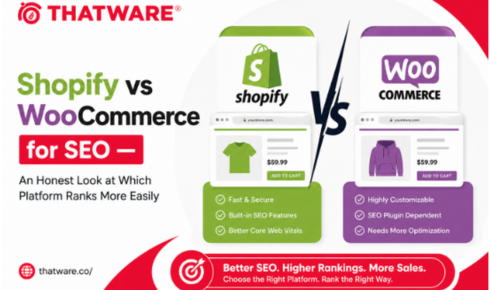
The Shopify versus WooCommerce decision gets made for many reasons: development resources, budget, feature requirements, technical flexibility. SEO is often a factor in the conversation but rarely the deciding one. Which is probably appropriate, because the platform difference in SEO outcomes is real but smaller than advocates on either side usually suggest.
Here’s what the platform choice actually affects, what it doesn’t, and how to think about the SEO dimension without overstating it.
What Shopify Gets Right for SEO Out of the Box
Shopify’s managed hosting infrastructure handles several technical SEO requirements automatically in ways that self-hosted WooCommerce stores need to configure deliberately.
SSL is automatic. Shopify sites are always served over HTTPS without additional configuration. Sitemaps are automatically generated and updated. Mobile responsiveness is built into every Shopify theme, though theme quality varies and mobile performance requires theme selection attention. Core Web Vitals scores tend to be more consistent on Shopify than on WooCommerce because Shopify controls the hosting environment and has optimized it across their customer base.
For merchants without technical development resources, these automatic implementations reduce the risk of basic technical SEO problems that commonly affect self-managed WordPress installations. A WooCommerce store managed by a non-technical owner can accumulate technical debt quickly: missing SSL, slow page speeds from unoptimized hosting, plugin conflicts that cause indexing issues.
Shopify seo services practitioners working within Shopify’s constraints know which technical limitations need workarounds and which can be addressed through app integrations or theme customization.
Where Shopify Creates SEO Limitations
Shopify’s managed environment also means less control over certain SEO elements that matter for competitive ecommerce stores.
URL structure is the most significant limitation. Shopify’s URL structure for products is fixed: /products/product-name. Collections use /collections/collection-name. You can’t restructure these to create the kind of URL hierarchy that might be preferable for complex catalog architectures. This is a real limitation but not one that typically produces dramatic ranking differences.
Duplicate content from /collections/ URLs is a known Shopify-specific issue. When products appear in multiple collections, Shopify creates multiple URLs for the same product. Canonical tag handling addresses this, but it requires attention and correct implementation.
JavaScript dependency is heavier in Shopify themes than in well-optimized WooCommerce setups. Pages that rely heavily on JavaScript for content rendering can have crawl and indexing implications if the JavaScript isn’t rendered properly by Googlebot.
Customization limits occasionally affect content strategy. Adding specific structured data types or implementing non-standard page architectures sometimes requires app workarounds or custom development that would be more straightforward in WooCommerce.
What WooCommerce Gets Right for SEO
WooCommerce’s flexibility is its primary SEO advantage. Running on WordPress, stores have full control over URL structures, page templates, content architecture, and plugin selection.
SEO plugin options are more comprehensive in the WordPress ecosystem. Yoast, Rank Math, and other WordPress SEO plugins provide structured data controls, breadcrumb management, and content optimization guidance that comparable Shopify apps don’t fully match.
Page speed optimization potential is higher in WooCommerce because every aspect of the hosting stack can be controlled and optimized. A WooCommerce store on fast managed WordPress hosting with a performance-optimized theme can achieve Core Web Vitals scores that beat comparable Shopify stores.
Content architecture flexibility allows WooCommerce stores to implement complex taxonomies, custom post types for non-product content, and URL structures designed around specific SEO strategies. This matters most for stores with complex catalog structures or content-heavy SEO strategies.
Ecommerce seo services for WooCommerce stores leverage this flexibility when it’s available and worth the additional development resources.
What Doesn’t Differ Between Platforms
The SEO factors that actually determine whether an ecommerce store ranks well for competitive terms are largely platform-agnostic.
Content quality on product and category pages is entirely platform-independent. Whether you write original, useful product descriptions or use manufacturer boilerplate affects rankings the same way regardless of platform.
Link profile quality is platform-agnostic. The authority signals pointing at your domain work the same way whether the store runs on Shopify or WooCommerce.
Topical authority built through blog content and information hub pages is equally achievable on both platforms and equally important for competitive category rankings.
Review signals and social proof, increasingly important for both rankings and conversion, work the same way on both platforms.
The Honest Verdict
For stores where the technical SEO requirements are straightforward and development resources are limited, Shopify’s managed environment reduces technical risk and produces good baseline SEO health with less ongoing maintenance. The platform limitations matter less than the consistency of technical implementation.
For stores with complex catalog structures, content-heavy SEO strategies, or technical teams capable of managing WordPress at scale, WooCommerce’s flexibility allows more sophisticated SEO architectures that can produce better outcomes in competitive categories.
Neither platform is an SEO advantage if the content, links, and user experience aren’t right. The platform is infrastructure. What you build on top of it determines whether you rank.